

Guides
From Abstract to Poster: How to Turn Your Accepted Abstract into a Conference Poster

From Abstract to Poster: How to Turn Your Accepted Abstract into a Conference Poster
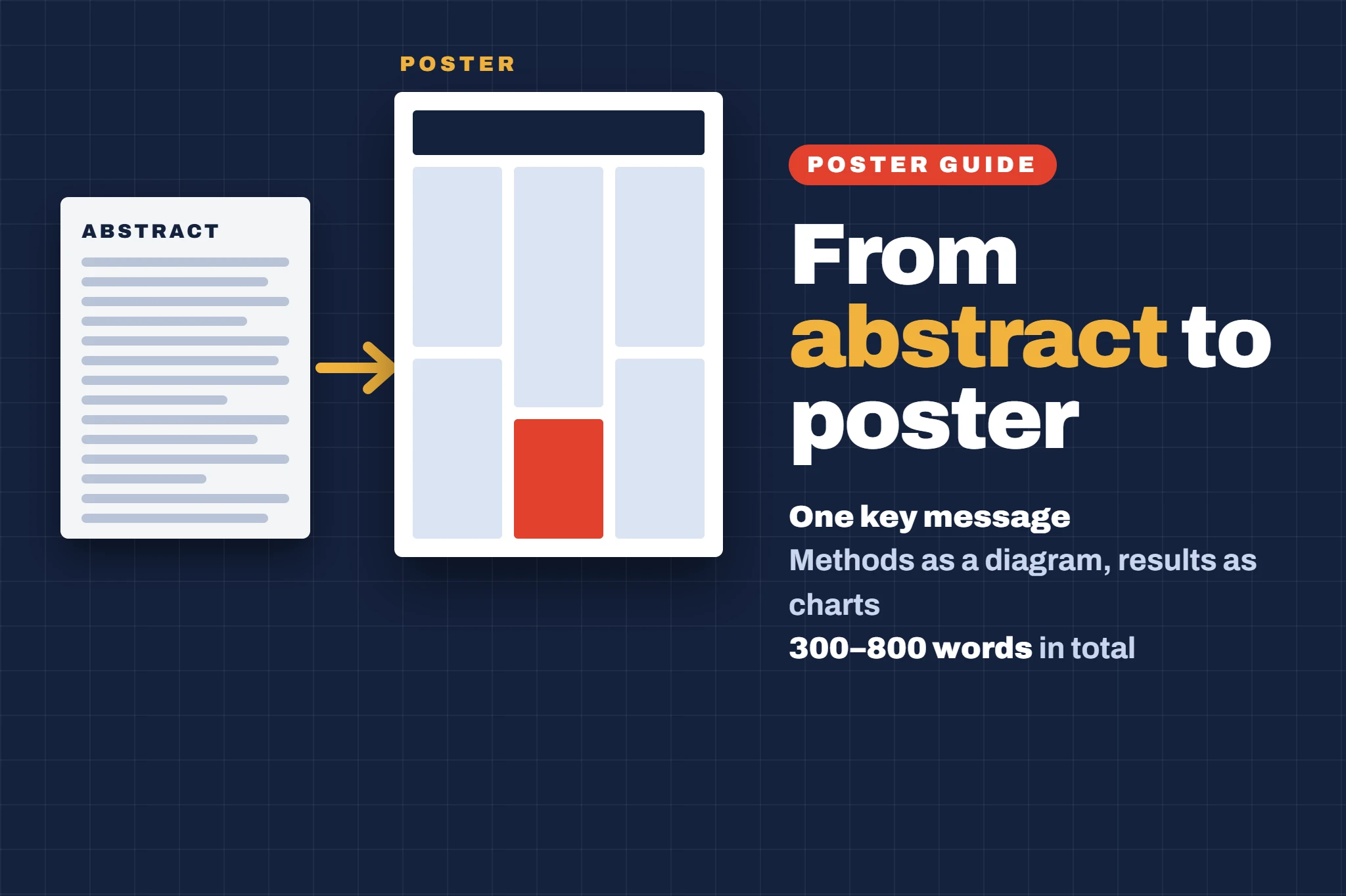
An abstract and a poster tell the same story in very different ways. An abstract is dense, written to be read at a desk. A poster is read standing up, from a metre or two away, in a few minutes, often while someone else is talking. So the job is not to copy your abstract onto a bigger page, but to reshape it into something people can take in at a glance.
Quick answer
To turn an accepted abstract into a poster, first check the conference’s poster size and rules, then pick one key message and rewrite your abstract as a short story: a clear title, a few lines of background, your methods as a diagram, your results as 2–4 charts, and 3 or so take-home points. Keep the whole poster to about 300–800 words, use big readable text, and leave yourself at least a week for checking and printing.
Pre-flight checks
- Rulessize, orientation and required content checked
- 1key message, your main finding, shown big
- 2–4charts carry the results
- 300–800words in total, not the abstract pasted in
- 1 weekat least, for checking and printing
01 / 08Read the poster instructions first
Before you open PowerPoint, find the presenter guidelines on the conference website or in your acceptance email. Look for:
- Size and orientation: most UK conferences ask for portrait A0 (841 × 1189 mm), but some want A1 or landscape. See what 18 UK conferences ask for and landscape vs portrait posters.
- Required content: some conferences want your abstract number, logos, a conflict of interest statement or a QR code.
- Deadlines: some ask for a PDF upload before the event, as well as the printed poster.
- Your presenting slot: so you know when the poster must be ready and on the board.
02 / 08Plan your timeline
Work backwards from the day you travel. A comfortable plan looks like this:
| When | What to do |
|---|---|
| 3–4 weeks before | Check the rules, choose your key message, sketch the layout |
| 2–3 weeks before | Build the poster: text, charts, figures |
| 10–14 days before | Send a draft to your supervisor and co-authors |
| 7 days before | Final changes, proofread, export a PDF |
| 3–5 days before | Order printing, so there is time for delivery and any surprises |
Short on time? Orders placed before 12PM (Monday–Friday) are printed the same day, and next-day delivery is available. See next day poster printing.
03 / 08Choose one key message
Ask yourself: if someone remembers only one sentence from my poster, what should it be? That sentence is usually your main finding. Make it the biggest thing on the poster after the title, near the top or in the centre, and build everything else around it.
04 / 08Map your abstract onto the poster
Your abstract already has the right parts. Each one just needs a different shape on the poster:
| Abstract section | On the poster |
|---|---|
| Title | A shorter, clearer title (under about 12 words) that can be read from across the room |
| Background | 2–4 short sentences or bullet points: why this matters |
| Aims | One sentence or a short question |
| Methods | A simple flow diagram or numbered steps, not paragraphs |
| Results | The biggest section: 2–4 clear charts or tables with short captions |
| Conclusion | 3 or so take-home points, in plain words |
| Not in the abstract | References, acknowledgements, funders, contact details and a QR code at the bottom |
- Short title, authors and logos
- Background, aims and methods diagram
- Results: your biggest charts
- Take-home points, references and QR code
For more detail on each part, see what to include on a research poster.
05 / 08Cut the words
Most abstracts are 250–300 words, and a good poster is 300–800 words in total, so you will add some detail but must keep it short. A few rules help:
- Use bullet points instead of paragraphs.
- Turn numbers into charts wherever you can.
- Remove anything that is not needed to understand the key message.
- Move extra detail, such as full methods, to a handout or a QR code.
Results changed since you submitted? Update them on the poster and say so briefly. Reviewers expect posters to show your latest data.
06 / 08Lay it out and make it readable
- Set the slide to the real print size before you add anything. Our free A0 and A1 PowerPoint templates are already set up.
- Use 3 columns on A0 portrait and 2 on A1, read top to bottom and left to right.
- On A0, aim for a title of 85–100 pt, headings of 36–48 pt and body text of 24–32 pt. See our academic poster font size guide.
- Leave plenty of white space, and use one or two colours that match your institution.
07 / 08Common mistakes
- Pasting the abstract text straight onto the poster
- Results hidden in small tables or long paragraphs
- A long title copied from the abstract submission system
- Not checking the size and orientation the conference asks for
- Leaving printing until the day before you travel
08 / 08Check, export and print
Print one section at 100% on A4 and read it from 2 metres away. Ask someone outside your field whether they can find your key message in under a minute. Then go through our academic poster checklist, export a PDF with image compression turned off, and check the page size before you send it to print.
Orders paid for before 12PM, Monday to Friday, are printed the same day. Then choose your delivery:
| Standard | Free · 2–3 working days |
| Royal Mail Tracked 24 & Signed | £6.99 · usually 1–2 working days |
| DPD Next Day | £9.99 · next working day |
| Royal Mail Special Delivery | £12.99 · next working day by 1PM |
Frequently asked questions
How long does it take to turn an abstract into a poster?
Plan for about 2–3 weeks of part-time work, plus time for feedback from co-authors and a few days for printing. A focused first draft can be done in a few days.
Should my poster have the same title as my abstract?
It should describe the same work, but you can usually shorten it so it can be read from across the room. Check the conference rules, as some ask you to keep the exact abstract title.
Should I put my abstract on the poster?
Only if the conference asks for it. Most posters leave the abstract out and show the same content as headings, bullet points and charts instead.
Can I add new results to my poster after the abstract was accepted?
Yes, in most cases. Posters usually show your latest data. Keep the main topic the same as your accepted abstract, and check the conference rules if the conclusions have changed a lot.
Sources and further reading
- Poster presenter guidance, International Nursing Research Conference 2026Royal College of Nursing (PDF)
- Poster presentation guidelines, BSA Annual Conference 2025British Sociological Association (PDF)
- Change the size of your PowerPoint slidesMicrosoft Support
- UK conference poster sizes: what 18 conferences ask forOur guide, with links to each conference’s own rules
